By Leah Strasser, Artist-in-Residence at The Shores
What constitutes a happy life?
Hungarian-American psychologist Mihaly Csikszentmihalyi believed that a key component is a psychological state of optimal experience called flow. When an artist becomes immersed in their painting, or a violinist feels no separation between their brain, body, and bow, their self-awareness dissolves, and they have seemingly entered a different place entirely — that place is flow. Flow is a state of deep engagement characterized by intense focus, intrinsic reward, and a balance between challenge and skill.
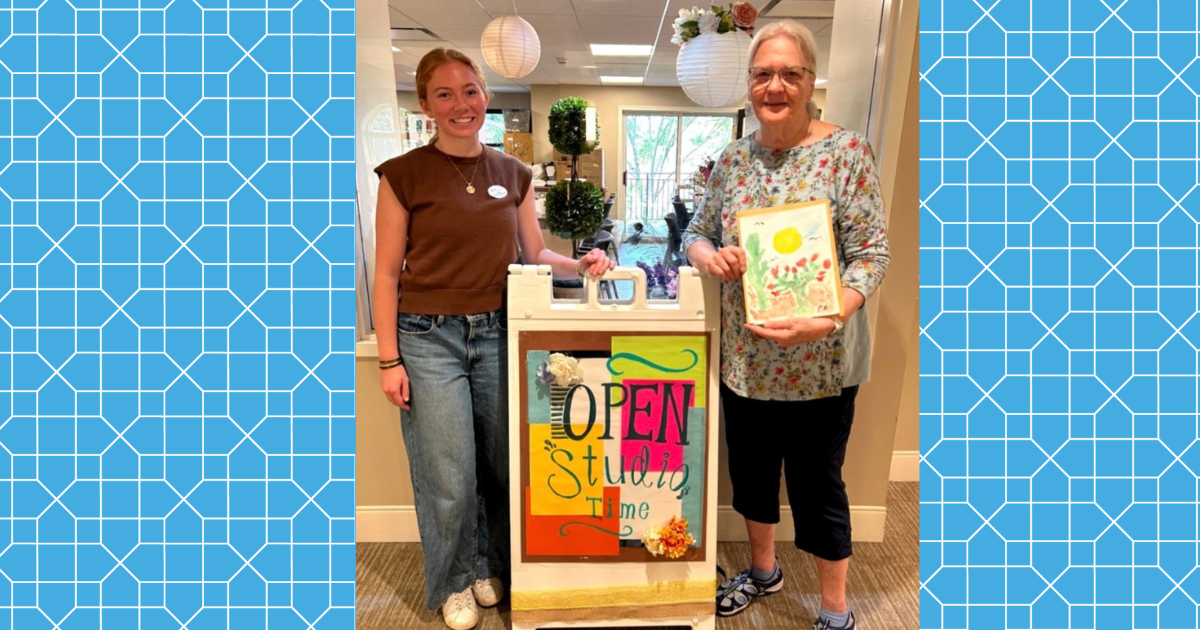
Flow is achieved through various avenues by different individuals — for me, it is art. As the Artist-in-Residence at The Shores this summer, I am an advocate for the benefits of art. When I facilitate classes with residents, I can often be heard saying the phrase, “It is about the process, not the product.” I explain this because they may not know that the “process” exercises problem-solving, creativity, and self-expression, while challenging them to adapt to novel experiences.
As we learn and try new things, our brains physically change. New neural connections are made, and old ones can be strengthened or weakened. Neuroplasticity is the brain's ability to change and adapt throughout life, reflected in changes to structure, function, and neural pathways. Research has shown that engagement in stimulating activities has been associated with improved cognitive health.
While this may sound intimidating, promoting neuroplasticity can be as simple as trying something new, challenging yourself, socializing, or even enjoying music. That’s why I always encourage residents at The Shores to come to my classes. They reap the benefits of socializing with others, being creative, and stimulating multiple senses simultaneously – which also activates the brain's reward system and reduces stress levels.
A growing body of research demonstrates that older adults maintain the ability to learn and reorganize neural pathways throughout life. As we age, art remains a uniquely accessible outlet for this continued growth. In my work with residents at The Shores, I have adapted artistic processes to meet a range of abilities, including those affected by Parkinson’s symptoms and stroke-related impairments. Creating in this context highlights the importance of fostering a supportive environment that encourages creativity and self-expression, while prioritizing each individual’s overall well-being. I invite you to create something — not because it needs to be “good,” but because it deserves to exist as the result of a meaningful and beneficial process.
With this neuroscientific foundation, I implore you to do what you are passionate about — what puts you in flow. I encourage you to make art, if not for the product, for the process. I ask you to break out of routine and try something new — a restaurant, recipe, walking route, puzzle, or board game. I ask you to embrace unfamiliar circumstances and not only broaden your horizons but also exercise your brain.
Challenge, create, and explore — you and your brain deserve it.
Join Us
The Shores will be hosting a Flow State Art Gallery on July 21, 2026 at 2:00 PM. This gallery will showcase resident art and expand on the topics described above. I will also deliver a presentation about my evidence-based approach to art programming at The Shores, drawing on current research to design experiences that are both creatively meaningful and neurologically informed. RSVP to Teresa at 609-391-6345 or Tfassel@umcommunities.org.
Sources Consulted
Bherer, Louis, et al. “A Review of the Effects of Physical Activity and Exercise on Cognitive and Brain Functions in Older Adults.” Journal of Aging Research, vol. 2013, no. 1, 2013, pp. 1–8, www.hindawi.com/journals/jar/2013/657508/, https://doi.org/10.1155/2013/657508.
Buckner, Randy L., et al. “The Brain’s Default Network.” Annals of the New York Academy of Sciences, vol. 1124, no. 1, Mar. 2008, pp. 1–38, https://doi.org/10.1196/annals.1440.011.
Dietrich, Arne. “Neurocognitive Mechanisms Underlying the Experience of Flow.” Consciousness and Cognition, vol. 13, no. 4, Dec. 2004, pp. 746–761, https://doi.org/10.1016/j.concog.2004.07.002.
Fisher, Jennifer. “Tips to Leverage Neuroplasticity to Maintain Cognitive Fitness as You Age - Harvard Health.” Harvard Health, 2 Apr. 2025, www.health.harvard.edu/mind-and-mood/tips-to-leverage-neuroplasticity-to-maintain-cognitive-fitness-as-you-age.
Fratiglioni, Laura, et al. “An Active and Socially Integrated Lifestyle in Late Life Might Protect against Dementia.” The Lancet Neurology, vol. 3, no. 6, June 2004, pp. 343–353, pubmed.ncbi.nlm.nih.gov/15157849/, https://doi.org/10.1016/s1474-4422(04)00767-7.
Kaimal, Girija, et al. “Reduction of Cortisol Levels and Participants’ Responses Following Art Making.” Art Therapy, vol. 33, no. 2, 23 May 2016, pp. 74–80, https://doi.org/10.1080/07421656.2016.1166832.
Kempermann, Gerd, et al. “More Hippocampal Neurons in Adult Mice Living in an Enriched Environment.” Nature, vol. 386, no. 6624, Apr. 1997, pp. 493–495, https://doi.org/10.1038/386493a0.
Mahncke, Henry W., et al. “Brain Plasticity and Functional Losses in the Aged: Scientific Bases for a Novel Intervention.” Progress in Brain Research, vol. 157, 2006, pp. 81–109, https://doi.org/10.1016/s0079-6123(06)57006-2.
Oppland, Mike. “8 Ways to Create Flow according to Mihaly Csikszentmihalyi.” PositivePsychology.com, 31 Mar. 2025, positivepsychology.com/mihaly-csikszentmihalyi-father-of-flow/.
Vessel, Edward A., et al. “The Brain on Art: Intense Aesthetic Experience Activates the Default Mode Network.” Frontiers in Human Neuroscience, vol. 6, no. 66, 2012, https://doi.org/10.3389/fnhum.2012.00066.